
Melvin Gibbs Ensemble: Nzambici
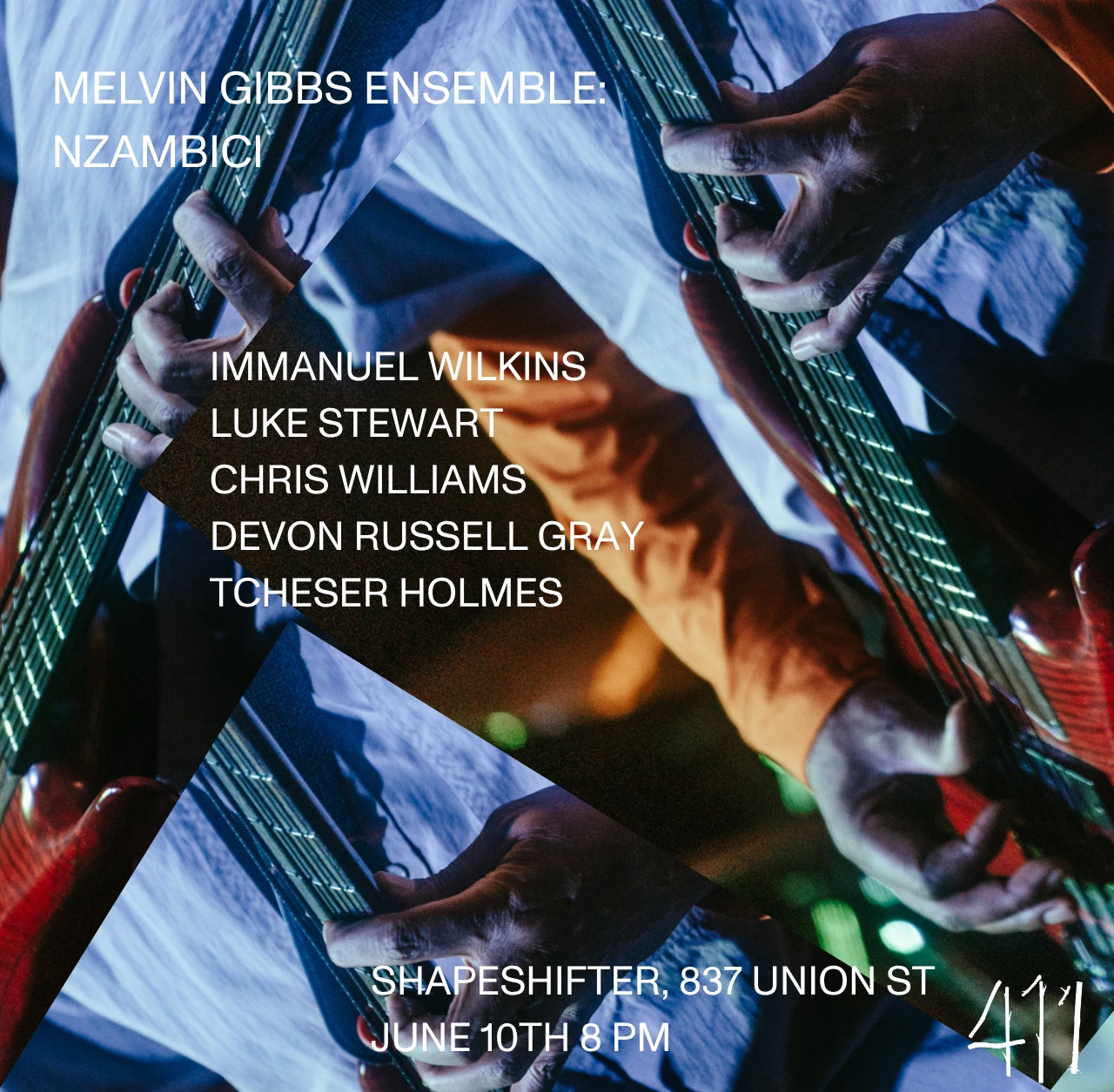
8pm/doors 7:30
The final performance in Melvin Gibbs’ multi-part residency with FourOneOne, Melvin Gibbs Ensemble: Nzambici is the second extended musical work created by Gibbs in consultation with theoretical cosmologist and jazz musician Stephon Alexander.
The first, Ogodo Quanta, was performed at the 2019 Vision Festival by an expanded version of God Particle, the musical group co-lead by Alexander and Gibbs. Taking inspiration from Philip Glass’s frequent explorations of scientific concepts and figures in his music, Gibbs will compose the work and Alexander will give creative and scientific advice, but neither will perform in the Melvin Gibbs Ensemble. Instead, they’ve hand-picked a group of creative musicians—saxophonist Immanuel Wilkins, trumpeter Chris Williams, pianist/keyboardist deVon Russell Gray, bassist Luke Stewart and drummer Tcheser Holmes—to implement their vision.
In his book How Black Music Took Over the World, around which this residency is structured, Gibbs draws parallels between quantum mechanics and the tri-poled logic of African cosmology. In his chapter “The Music of Black Science,” he describes the presence of three-valued superpositioned states (true, false, and both true and false) in the Yoruba and Igbo folklore, which originated in West African and spread throughout the Caribbean and the Americas as a result of the transatlantic slave trade.
Alexander's book The Jazz Of Physics explores the connection between John Coltrane and Albert Einstein and the myriad links between theoretical physics and jazz improvisation. Alexander describes how connection to music has informed the development and work of science. Gibbs thought the book laid out the basis for an exploration in the inverse direction—a musical project, developed around ideas informing theoretical cosmology, that explores the concepts scientists see in the quantum world. Gibbs reached out to Alexander to establish a collaboration exploring The Jazz Of Physics, and God Particle was born. Gibbs developed a harmonic system inspired by Alexander’s work that he used in Ogodo Quanta. The Melvin Gibbs Ensemble has been assembled as a vehicle to present the music generated by that system.
Ogodo Quanta was a sonic meditation on the idea of the “Cosmic Fabric,” the interconnected cosmic force. Nzambici is the female counterpart to Nzambi, the name the Bantu Bakongo gave God the Creator. Nzambici is God as “She.” The music created under her name will be a sonic meditation on the idea of Creative Force.
8pm/doors 7:30
The final performance in Melvin Gibbs’ multi-part residency with FourOneOne, Melvin Gibbs Ensemble: Nzambici is the second extended musical work created by Gibbs in consultation with theoretical cosmologist and jazz musician Stephon Alexander.
The first, Ogodo Quanta, was performed at the 2019 Vision Festival by an expanded version of God Particle, the musical group co-lead by Alexander and Gibbs. Taking inspiration from Philip Glass’s frequent explorations of scientific concepts and figures in his music, Gibbs will compose the work and Alexander will give creative and scientific advice, but neither will perform in the Melvin Gibbs Ensemble. Instead, they’ve hand-picked a group of creative musicians—saxophonist Immanuel Wilkins, trumpeter Chris Williams, pianist/keyboardist deVon Russell Gray, bassist Luke Stewart and drummer Tcheser Holmes—to implement their vision.
In his book How Black Music Took Over the World, around which this residency is structured, Gibbs draws parallels between quantum mechanics and the tri-poled logic of African cosmology. In his chapter “The Music of Black Science,” he describes the presence of three-valued superpositioned states (true, false, and both true and false) in the Yoruba and Igbo folklore, which originated in West African and spread throughout the Caribbean and the Americas as a result of the transatlantic slave trade.
Alexander's book The Jazz Of Physics explores the connection between John Coltrane and Albert Einstein and the myriad links between theoretical physics and jazz improvisation. Alexander describes how connection to music has informed the development and work of science. Gibbs thought the book laid out the basis for an exploration in the inverse direction—a musical project, developed around ideas informing theoretical cosmology, that explores the concepts scientists see in the quantum world. Gibbs reached out to Alexander to establish a collaboration exploring The Jazz Of Physics, and God Particle was born. Gibbs developed a harmonic system inspired by Alexander’s work that he used in Ogodo Quanta. The Melvin Gibbs Ensemble has been assembled as a vehicle to present the music generated by that system.
Ogodo Quanta was a sonic meditation on the idea of the “Cosmic Fabric,” the interconnected cosmic force. Nzambici is the female counterpart to Nzambi, the name the Bantu Bakongo gave God the Creator. Nzambici is God as “She.” The music created under her name will be a sonic meditation on the idea of Creative Force.